Building a Technology Team:
When to Hire, When to Partner
For growing companies, technology decisions eventually become business decisions.
What may have started with a few employees handling IT needs, an outside provider responding to tickets, or one trusted person who seems to know how everything works can become something much bigger as the organization grows.
At some point, leadership teams begin asking different questions.
Do we need an internal technology leader? Do we need more technical capacity? Are we getting what we need from our current partner? Should we outsource more? And perhaps the hardest question: How do we know what we actually need?
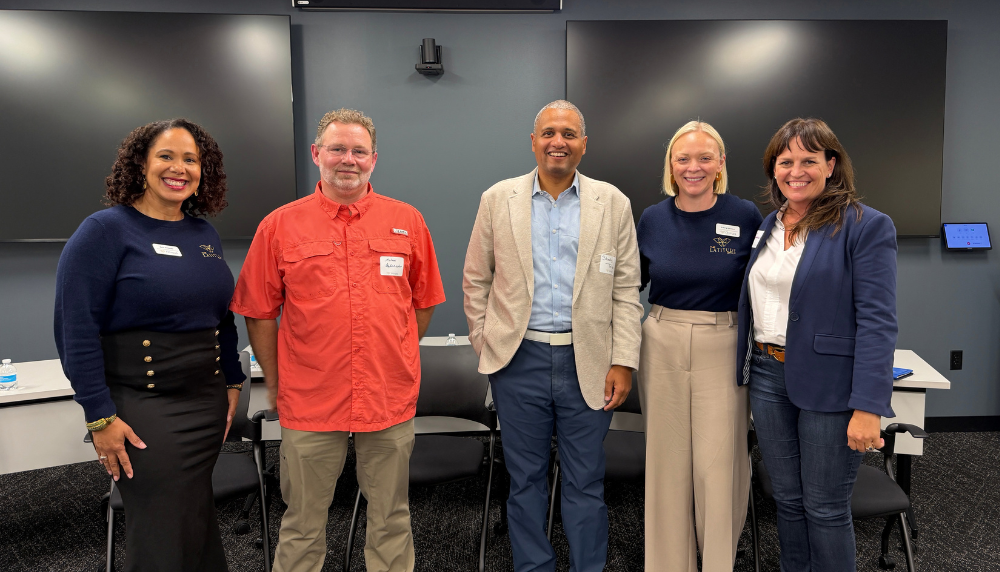
Those questions were at the center of Building a Technology Team: When to Hire, When to Partner, a panel discussion hosted by The Latitude Group and Blue Net on September 29, 2026.
The conversation brought together leaders who approach technology team-building from different perspectives: Angie Wittke, CEO of Blue Net; Hillary Spreizer, CEO of The Latitude Group; Shady Taha, a CIO leading technology within a growing healthcare company; and Michael Rademacher, Director of Information Technology at QualiTech. Kelli Williams, Culture & Marketing Leader at The Latitude Group, moderated the discussion.
The idea for the event began with a conversation between Wittke and Spreizer. Both were seeing growing organizations wrestle with similar questions from different sides: Blue Net through its work as a managed service provider and The Latitude Group through its work helping companies build technology teams.
The conversation reinforced that there is no universal formula for when to hire and when to partner. But several principles emerged that can help leadership teams make better decisions about the technology capabilities their businesses need.
Start with the business problem, not the org chart
“Should we hire or should we outsource?” may be the wrong first question.
Before deciding how to structure a technology team, leaders need to understand what the business is trying to accomplish.
Where are the gaps today? What is creating risk? What capabilities does the organization need now and what will it need as it grows?
The panel discussed how organizations can sometimes jump too quickly to a solution. A technology issue emerges, so the instinct is to hire an IT person. A team becomes overwhelmed, so the assumption is that another employee will solve the problem.
But adding headcount without first defining the problem can result in hiring for today’s pain rather than tomorrow’s need.
A better starting point is to define the business problem, identify the capabilities required to solve it, and then determine the best way to access those capabilities.
Know what you are actually hiring for
If the answer does include hiring internally, the next question matters just as much: Who do you actually need?
A strategic technology leader and a hands-on technical professional solve very different problems. As organizations grow, needs that once centered on troubleshooting and keeping systems running can expand into cybersecurity, infrastructure strategy, systems integration, risk management, vendor management and long-term technology planning.
The person who is excellent at keeping today’s technology running may not necessarily be the person equipped to build tomorrow’s technology strategy.
Before beginning a search, leadership teams should be clear about the business outcomes the role needs to own, the problems the person is being hired to solve and the level of strategic versus tactical capability required.
While the specific skill sets may differ depending on the technology need, the logic holds: define what the business needs the role to accomplish before deciding who to hire.
The goal isn’t simply to hire an IT person. It’s to hire the right person for the work the business actually needs done.
The answer doesn’t have to be hire or partner
One theme surfaced repeatedly throughout the conversation: for many organizations, the strongest model may be a combination of internal talent and external expertise.
Certain capabilities may be important to own internally because they are closely tied to the company’s operations, people or competitive advantage. Other capabilities require specialized expertise that may be difficult or unnecessarily expensive to maintain entirely in-house.
The question then becomes less about choosing sides and more about intentionally designing the right ecosystem:
- What do we need to own?
- What can we access through a partner?
- And how do those pieces work together?
For many growing organizations, the right model is a combination: internal leadership and business knowledge supported by outside expertise that provides specialized capabilities, flexibility or scale.
The right model should be based on what the organization is trying to accomplish and what will allow it to scale, not simply on how many people sit inside the technology department.
The right people and partners need to understand the business
Whether the expertise sits inside the organization or comes from an outside partner, technical capability alone isn’t enough.
For an external provider, one of the best signals may be the questions they ask. Are they asking where the company is going? Do they understand the organization’s business goals? Are they curious about the team, growth plans and challenges leadership is trying to solve?
A provider doesn’t become a strategic partner simply because the relationship has existed for a long time. Strategic partnership requires understanding the business well enough to anticipate needs, challenge assumptions and help leaders make better decisions.
The same principle applies internally. Leaders need to consider more than what someone knows technically. Can they learn, collaborate, share knowledge and evolve as the organization changes?
Strong technology leadership requires the ability to set direction, create accountability and build a culture where knowledge moves throughout the organization rather than being protected by a few individuals.
Whether hiring an employee or selecting a partner, the question isn’t only “Can they do the work?” It’s also “Can they help us move the business forward?”
That business-first approach also reflects the perspective Blue Net brought to the conversation as a managed service provider, including the importance of aligning IT decisions with operations, risk, growth and long-term business priorities.
Leaders should also pay attention to dependency. Sometimes dependency can look like expertise. If critical systems, history or knowledge live with one employee or provider, what feels efficient today can become organizational vulnerability tomorrow. Healthy technology organizations document, share and transfer knowledge so the business isn’t dependent on any one person or partner to function.
Technology decisions are leadership decisions
When technology problems surface, it’s natural to look first at the technology team or technology provider.
But the underlying issue may have started somewhere else: misalignment among leaders, poor communication, unclear ownership, lack of executive sponsorship or a decision that was never fully supported throughout the organization.
Those issues eventually show up downstream, and technology may simply be where the symptoms become visible.
That became especially relevant during the panel’s discussion of change management. Whether an organization is bringing in a new partner, changing its technology structure or asking employees to work differently, making the decision is only the beginning.
Leaders also have to communicate, reinforce and support the change throughout the organization.
Building for what comes next
The conversation reinforced something The Latitude Group sees regularly in its work with growing organizations: building a technology team isn’t simply a hiring decision. It’s a business decision.
Company size alone won’t provide the answer. Neither will headcount or the latest technology trend.
The right structure depends on where the business is going, what capabilities it needs to get there, which expertise makes sense to own internally, and where an outside partner can provide greater depth, flexibility or scale.
For leadership teams wrestling with the decision, consider starting with these questions:
- What business problem are we actually trying to solve?
- What capabilities do we need today, and what will we need next?
- Which knowledge and leadership should live inside our organization?
- Where would specialized outside expertise make us stronger?
- Are our people, partners and leadership team aligned on what success looks like?
The goal isn’t to build the biggest internal technology team or outsource the most work.
It’s to build the right combination of people, expertise, leadership and partnerships to support where the business is going next.
And getting that combination right starts long before the job description is posted or the partner is selected. It starts with understanding the business, defining what success requires and building from there.
Related Reading
Building Better Business Decisions Through Strategic Talent Consulting
How The Latitude Group helped a client look beyond an initial hiring request to design a talent strategy aligned with the business outcomes it needed to achieve.
Doing More with Less: How High-Performing Teams Stay Focused on What Actually Matters
A look at why strong teams aren’t defined by headcount, but by clarity, prioritization and alignment around the work that creates the most value.
AI-Enabled Admissions Automation in Behavioral Healthcare + The Latitude Group
How specialized technology talent helped a healthcare organization explore AI around a clearly defined business challenge while balancing innovation, human judgment and risk.
The Latitude Group is a woman-owned IT recruiting and staffing firm based in the Twin Cities, serving clients nationwide. For more than 24 years, we’ve helped organizations build high-performing technology teams through contract, contract-to-hire and direct-hire solutions.
Our approach begins with understanding the business need, then designing the right talent strategy to support it. With a relationship-driven approach and 90%+ consultant retention rate, we believe the best technology teams are built through the right combination of expertise, alignment and fit.
Blue Net is a Minnesota-based managed IT and cybersecurity partner helping manufacturers keep information flowing so production keeps moving.
Technology connects your people, systems, machines, plant floor, and front office. Blue Net helps manufacturers understand those connections, reduce risk, and build a technology strategy that supports the business.
Keep information flowing. Keep production moving.